
Aircraft & systems · 6 min read
What happens if an engine fails (and why planes are built for it)
What changes after an engine failure? A pilot’s look at the aircraft’s capabilities, crew preparation, and decisions about where to land.

An airliner doesn’t suddenly stop flying when one engine stops producing thrust. On a typical twin-engine airliner, the remaining engine can keep the airplane flying within its performance limits. What changes is the plan.
It’s a serious event, but much of the preparation for it is invisible from the passenger cabin. To understand what happens next, it helps to look at the questions the crew needs to answer: what can the airplane do now, how far can it go, and where should we land?
The wings are still doing their job
The engines push the airplane forward; the wings generate most of the lift as air flows around them. Losing engine thrust doesn’t make that lift disappear all at once.
Even without any engine thrust, an airplane can glide while descending, as long as it has the airspeed and flight conditions it needs. Holding altitude is a different question—and that’s where the remaining engine’s performance matters.
Why might the airplane descend?
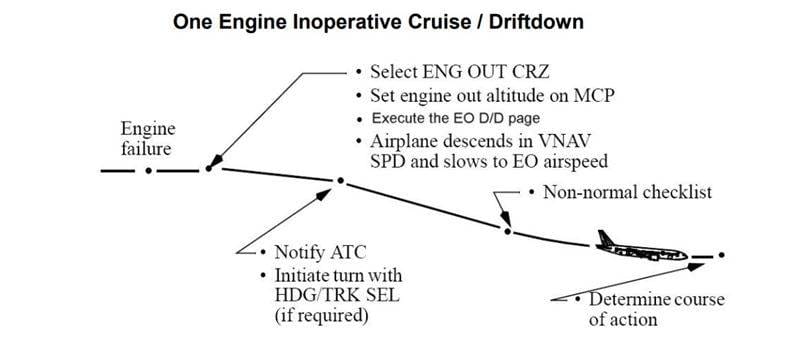
The altitude that works with two engines may be too high for one. Depending on the airplane’s weight and the conditions, the crew may need to descend to an altitude where the remaining engine can sustain level flight.
That descent is called a drift-down. The word may sound as though the airplane is aimlessly drifting, but it describes a planned response to a performance limit. The crew uses the aircraft’s specified speed and performance data to manage the flight path.
Terrain matters throughout the descent. It isn’t enough to know that the airplane can eventually level off lower; the route to that altitude also needs to clear the mountains or other obstacles along the way.
A new altitude means a fresh look at the fuel
The original fuel prediction was based on a particular route, speed and altitude. Once those change, the crew needs a prediction that matches the new plan: the descent, the flight to the diversion airport and the arrival.
One engine being off doesn’t simply halve the fuel needed. The remaining engine is still using fuel, and the time to the airport matters. For a given hourly fuel burn, a stronger headwind means more minutes using fuel for each mile covered over the ground.
This is why pilots look at more than the fuel quantity on a display. The useful question is whether that fuel is enough for the flight the airplane can now make. Aircraft performance data supplies the numbers; there is no single engine-out fuel percentage that fits every situation.
How do we choose where to land?
The closest airport symbol on a map is only a starting point. Can we reach it with the fuel and performance available? Does the route clear the terrain? Can the airplane land on the available runway in the weather we expect to find?
The condition of the aircraft matters too. A problem that creates greater urgency can change the decision. For the U.S. twin-engine airline operations discussed here, the landing rule is the nearest suitable airport in point of time at which a safe landing can be made. Suitability and time both count.
The crew has people and tools to help answer those questions. Air traffic control can assist with routing and emergency coordination. Dispatch can provide updated information and planning support. Maintenance control may offer technical advice about the malfunction. The aircraft manuals, checklists and performance tools provide the details for that particular airplane.
The captain and crew bring that information together using their training and judgment. A company maintenance base may be convenient, but convenience is not a reason to bypass a nearer suitable landing option. Support informs the decision; the captain retains responsibility.
The preparation starts before anything goes wrong
Engine-out performance is part of takeoff planning. Runway length, weight, temperature, wind and obstacles all help determine what the airplane can do. If the conditions don’t support the required performance, something has to change before departure—such as the weight or the departure conditions.
Pilots also practice engine failures in training, including demanding takeoff and approach scenarios. The work includes controlling the airplane, following the flight path, using the relevant procedures and coordinating as a crew.
For instance; you may have heard the takeoff call “V1.” It is a calculated speed used in the stopping-and-continuing plan, not the speed at which an engine fails, it Is a calculate decision speed that means when we reach that airspeed, we will take the aircraft into the air, and deal with any problems in flight versus trying to stop with not enough runway remaining. This plan is much more safe. The plan is worked out and discussed well before we even pushback from the gate.
The exact actions differ between aircraft and airlines. What matters for passengers is that the response is prepared and practiced, with checklists and aircraft-specific guidance to support the crew.
What if we’re over the ocean?
Being far from an airport adds another layer of planning. Applicable long-range flights operate under requirements known as ETOPS—extended operations—which address reliability, procedures and diversion planning.
For U.S. ETOPS fuel planning, the airline compares three cases: an engine failure, a rapid loss of cabin pressure, and both happening together at the most critical point. The greatest diversion fuel requirement is used, along with the rule’s other allowances. All of these scenarios are in our flight planning, meaning we are prepared for the scenarios and have a plan for a safe outcome at every part of the flight.
Diversion decisions include wind uncertainty, icing, deterioration in fuel-burn performance, holding and landing, and fuel for the auxiliary power unit (backup power) when required. The idea is to account for a changed flight plan before that change is needed. It does not mean every overwater flight follows the same ETOPS approval or diversion limit, but there is always a contingency plan in place.
What would passengers notice?
A change in engine sound or flight path doesn’t tell you, by itself, what has happened. From the cabin, you might notice the airplane doing something different without knowing why.
The crew’s immediate attention will be on flying the airplane and handling the situation. An explanation to passengers may come once workload allows. In the meantime, follow the flight attendants’ instructions; you don’t need to diagnose the problem from your seat.
What about losing thrust from both engines?
That is a different, more serious emergency than continuing with one engine operating. The airplane can still glide while descending, but the crew has to manage its energy and available landing options, following the procedures for that aircraft.
US Airways Flight 1549 is a well-known example. After bird strikes caused a near-total loss of thrust in both engines in 2009, the crew ditched the A320 in the Hudson River. All 155 people aboard survived. That outcome was remarkable.
The view from the flight deck
An engine failure changes the crew’s priorities, but it doesn’t erase the planning and training behind the flight. The descent, the fuel calculations and the diversion are connected parts of getting the airplane to a suitable landing.
You don’t need to learn a cockpit checklist to understand that picture. Knowing why the crew might descend or choose a different airport can make those decisions feel a little less mysterious.
Sources and scope
General passenger education about typical transport-category twin-engine airliners. U.S. Part 121 and ETOPS requirements are identified where discussed; procedures and equipment vary. The Flight 1549 example is specifically an A320.
These sources support the general explanation above. Aircraft-specific procedures and approved performance data take precedence in flight operations.
- NASA Glenn — Four Forces on an Airplane
- 14 CFR 25.121 — One-engine-inoperative climb
- 14 CFR 121.191 — One-engine-inoperative en route limits
- 14 CFR Part 121 Appendix E — Flight training
- 14 CFR 121.427 — Recurrent training
- 14 CFR 1.2 — V1 definition
- 14 CFR 121.189 — Takeoff limitations
- 14 CFR 121.161 — Route limitations
- FAA AC 120-42B — ETOPS and polar operations
- 14 CFR 121.565 — Engine inoperative: Landing
- NTSB AAR-10/03 — US Airways 1549
- 14 CFR 121.424 — Pilot flight training
- 14 CFR 121.646 — ETOPS diversion fuel
- 14 CFR 121.535 — Operational control, flag operations
- ATSB AO-2016-101 — Engine failure and diversion decision
- FAA AIM 6-1 — Emergency responsibility and assistance
General passenger education, not an aircraft checklist or operating instruction. Follow your flight crew’s instructions.
The cockpit notebook
Why the next altitude may be lower

Tap or click the diagram to view its labels at full size.
If the aircraft is above the altitude it can maintain with one engine inoperative, it may need to descend. Crews use the aircraft’s approved performance information to work out the appropriate profile.
Source: 14 CFR 121.191. Original FSNS concept diagram.
The cockpit notebook
A new profile needs a new fuel assessment
What changed?
Altitude, speed, route, wind and the condition of the aircraft.
What gets recalculated?
Fuel required to reach a suitable landing airport using the actual aircraft’s performance information.
What is the answer?
It is not a universal percentage. One operating engine does not simply mean half the fuel.
Conceptual explanation, not a fuel-planning worksheet. Source: FAA AC 120-42B.
The cockpit notebook
The crew has more than one source of help
Aircraft performance
Approved aircraft information and the operator’s performance tools.
ATC
Traffic coordination, clearances and assistance with the diversion.
Dispatch / operations
Weather, airports, routing and operational support where available.
Maintenance control
Technical support within its role and the operator’s procedures.
Company manuals
Aircraft-specific checklists, procedures and operating policies.
Crew judgment
Training, experience and the information available at the time.
The captain remains responsible for the decision. Suitability includes the runway, weather, terrain, aircraft condition and the ability to make a safe landing. For U.S. Part 121 twin-engine operations, the engine-inoperative rule calls for the nearest suitable airport in point of time.
Scope and exceptions: 14 CFR 121.565. This is an explanation, not a diversion checklist.
General passenger education. Aircraft equipment and procedures vary. This article is not a checklist or operating instruction.
← Explore more aviation articles